Insights
Architectural vs 3-Tab Shingles: Which Is Right?
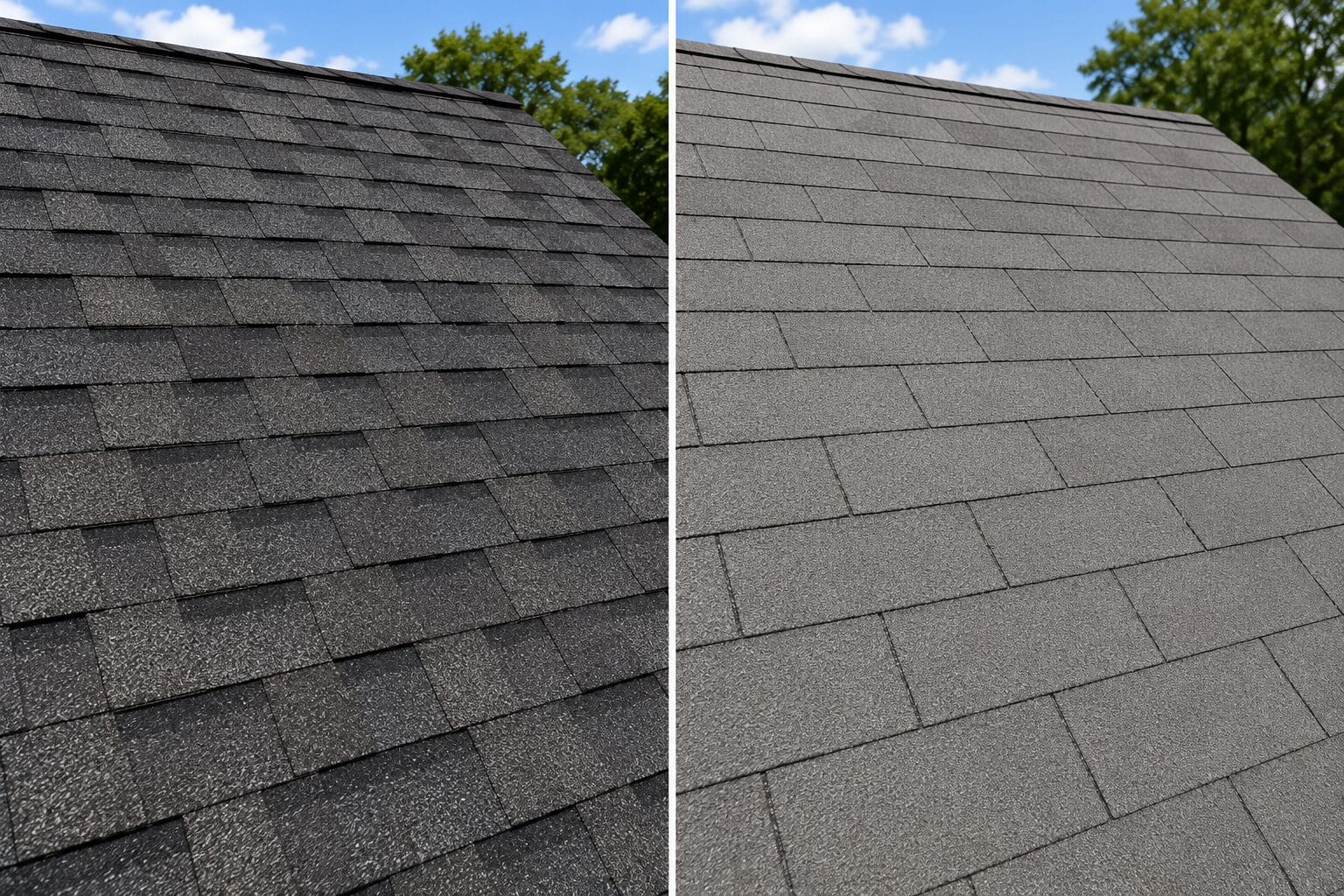
If you’re replacing a roof in Colorado, one of the first decisions you’ll face is choosing between architectural shingles and 3-tab shingles. Both are asphalt-based, both are widely available, and at first glance they might seem interchangeable. They’re not.
The differences between these two shingle types matter a lot in Colorado specifically, where hail is a recurring reality, UV exposure is amplified by altitude, and temperature swings can be extreme. The choice you make will affect your home’s protection, your insurance premium, and how long it’ll be before you’re going through this process again.
Here’s what you need to know to make the right call.
What Are 3-Tab Shingles?
3-tab shingles are the traditional asphalt shingle design. Each shingle strip has two evenly spaced cutouts along the bottom edge that create three individual-looking tabs. They lay completely flat when installed, producing a uniform, two-dimensional appearance across the roof.
They’ve been a staple of residential roofing since the 1930s and for a long time were the default option for most homes. The main reason they’re still around today is cost. 3-tab shingles are among the least expensive roofing materials you can put on a house.
The tradeoff is that they’re also the thinnest and least durable option. A single layer of asphalt doesn’t have much to offer when a hailstone hits at 60 mph, and their flat profile creates more surface area for wind to get underneath. Most standard 3-tab shingles are rated for 60 to 70 mph winds, which sounds like a lot until you’ve watched a Colorado thunderstorm roll across the Front Range.
It’s also worth noting that 3-tab shingles are being phased down by major manufacturers. Fewer color options are available than they were a decade ago, and getting an exact match for repairs becomes harder every year as product lines are discontinued.
What Are Architectural Shingles?
Architectural shingles, also called dimensional shingles or laminate shingles, are built with multiple layers of asphalt fused together over a heavy fiberglass mat. That laminated construction creates a shingle that’s roughly 50% heavier per square than a 3-tab, with a textured, three-dimensional profile that mimics the look of wood shakes or natural slate.
They’ve been the dominant residential roofing product for new installations in North America for the past two decades, and for good reason. The multi-layer construction delivers meaningfully better performance across every category that matters: wind resistance, hail resistance, lifespan, and warranty coverage.
Architectural shingles are also available with Class 4 impact-resistant ratings, which is a significant consideration in Colorado and something we’ll dig into below.
3-Tab vs. Architectural Shingles: How They Compare
Here’s how the two shingle types stack up across the factors that matter most for Colorado homeowners.
| Category | 3-Tab Shingles | Architectural Shingles |
|---|---|---|
| Construction | Single asphalt layer | Multiple laminated layers |
| Appearance | Flat, uniform, 2D | Textured, dimensional, 3D |
| Wind Resistance | 60–70 mph | 80–130 mph |
| Hail Resistance | Unrated | Class 3 or Class 4 available |
| Typical Lifespan | 15–25 years | 25–50 years |
| Warranty | 20–30 years | 30 years to lifetime |
| Installed Cost | $3–$5 per sq ft | $5–$9 per sq ft |
| Insurance Discounts | None | Up to 20–30% with Class 4 |
| Style Options | Limited, declining | Wide range |
| Home Value Impact | Minimal | Positive |
Why the Difference Matters More in Colorado
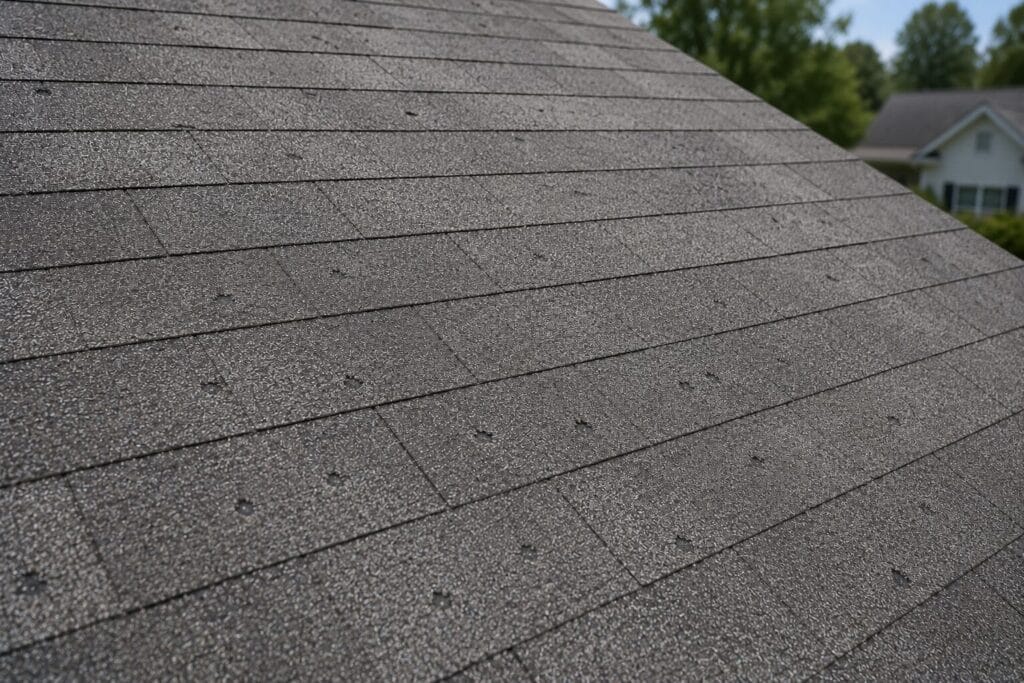
For homeowners in mild climates with low storm exposure, the case for architectural shingles is still strong but less urgent. In Colorado, it’s a different story.
Hail
Colorado sees some of the highest hail frequency in the country. The corridor stretching from the southern suburbs of Denver north through the metro area into Weld County is sometimes called the hail belt for good reason. Hailstones large enough to damage roofing materials are a regular occurrence along the Front Range during late spring and summer.
Standard 3-tab shingles carry no impact resistance classification. Most standard architectural shingles earn a Class 3 rating. Class 4 architectural shingles, the highest available rating under the UL 2218 impact resistance standard, are specifically engineered to withstand impacts from 2-inch hailstones without cracking or rupturing.
That Class 4 rating also has a financial component. Many homeowners insurance carriers in Colorado offer discounts of 20 to 30 percent on the roof portion of your premium for homes with Class 4 impact-resistant shingles. For some homeowners, that annual savings alone can substantially offset the higher upfront cost of the upgrade over the life of the roof. It’s worth calling your insurance carrier before finalizing your material selection.
UV Exposure
Colorado gets more than 300 days of sunshine per year, and at a mile of elevation that sun hits with more intensity than it does at lower altitudes. UV radiation is one of the primary factors that ages asphalt shingles over time, breaking down the granule adhesion and causing the underlying asphalt to become brittle and crack.
The thicker construction of architectural shingles handles UV degradation better than 3-tab simply because there’s more material to work through before the shingle fails structurally. 3-tab shingles, already thinner, tend to show UV wear sooner and more visibly.
Temperature Swings
Colorado is famous for dramatic temperature changes. A warm afternoon in March can give way to a foot of snow by evening. These wide swings drive repeated thermal expansion and contraction in roofing materials.
Architectural shingles handle thermal cycling better because the laminated construction distributes stress across multiple layers. A single-layer 3-tab shingle absorbs that stress entirely at the surface, which accelerates cracking and tab lifting over time.
Wind
Colorado mountain communities and the foothills can see serious wind events. Architectural shingles, rated for 80 to 130 mph depending on the product, offer a significant safety margin over the 60 to 70 mph rating typical of 3-tab shingles.
The Class 4 Shingle Conversation
If you’re replacing a roof in a Colorado location with meaningful hail exposure, the conversation about Class 4 impact-resistant shingles is worth having before you default to a standard product.
Class 4 architectural shingles are available from most major manufacturers, including impact-resistant lines from GAF, Owens Corning, CertainTeed, and Malarkey. They use modified asphalt formulations, rubberized polymers, or reinforced fiberglass mats to achieve their impact rating, and they carry the same dimensional appearance as standard architectural shingles.
The premium over standard architectural shingles is real but often modest, typically 10 to 20 percent more per square in material cost. When you factor in potential insurance discounts and the reduced likelihood of storm-related repairs over the roof’s life, the math often works in favor of upgrading.
For a deeper look at how shingle selection fits into the broader picture of roofing materials in Colorado, our guide to the best roofing materials for Colorado homes covers the full range of options and what works best in different situations.
What About Cost?

Let’s be direct about the numbers. Architectural shingles cost more upfront than 3-tab shingles. That’s real, and it’s a legitimate consideration for homeowners on a tight budget.
For a typical Colorado home, the installed cost difference between a 3-tab roof and a standard architectural shingle roof runs roughly $2,000 to $6,000 depending on roof size and complexity. Upgrading further to Class 4 impact-resistant architectural shingles adds another 10 to 20 percent on top of that.
The question is whether that upfront premium is a good investment over time. Here’s one way to think about it: a 3-tab roof on a Colorado home might realistically last 15 to 20 years before needing full replacement. An architectural shingle roof on the same home could last 30 years or more with proper maintenance. If you replace a 3-tab roof twice over 30 years, you’ve spent considerably more than one architectural shingle installation would have cost from the start.
Add in potential insurance premium savings from Class 4 shingles, fewer storm-related repair bills, and the resale value benefit of a newer and higher-quality roof, and the long-term financial case for architectural shingles is strong for most homeowners who plan to stay in their home for more than 10 years.
Is There Any Reason to Choose 3-Tab?
There are situations where 3-tab shingles make sense. If you’re roofing a detached garage, a shed, or another outbuilding where longevity and appearance aren’t priorities, the lower upfront cost is a reasonable trade-off. If you need to match an existing 3-tab roof for a partial repair and the color is still available, it may be the right practical choice.
For the primary roof on a Colorado home where the family lives, the case for 3-tab shingles is thin. The climate is too demanding and the roof is too important an asset to optimize purely on upfront cost.
Which Should You Choose?
For the vast majority of Colorado homeowners replacing a primary roof, architectural shingles are the right call. They perform better in the conditions Colorado actually delivers, they last longer, they carry stronger warranties, and they’re a better long-term investment.
If your home is in a hail-exposed area, particularly along the Front Range, upgrading to Class 4 impact-resistant architectural shingles is worth a serious conversation with your contractor. The combination of better storm protection and potential insurance savings makes a compelling case.
If budget is the primary constraint, standard architectural shingles at 30-year warranty still represent a much better long-term investment than 3-tab for a primary residence.
Get the Right Shingles for Your Colorado Home
At Roof Source, we help homeowners across Colorado choose the right roofing materials for their specific home, location, and budget. No matter if you’re comparing shingle options for a full replacement or recovering from storm damage, we’ll give you an honest assessment and a clear recommendation.
Schedule Your Free Roof Inspection Today!
Frequently Asked Questions
What is the difference between architectural shingles and 3-tab shingles?
The primary difference is construction. 3-tab shingles are a single layer of asphalt that lays flat. Architectural shingles, also called dimensional shingles, use multiple laminated layers of asphalt that create a thicker, textured profile. That additional construction translates into better wind resistance, hail resistance, longer lifespan, and stronger warranty coverage.
Are architectural shingles worth the extra cost in Colorado?
For most Colorado homeowners, yes. The state’s hail frequency, UV intensity, and temperature swings are hard on roofing materials, and architectural shingles handle all of those conditions better than 3-tab shingles. The longer lifespan, stronger warranties, and potential insurance savings from Class 4 options often make the upfront premium worthwhile over the roof’s life.
What are Class 4 impact-resistant shingles?
Class 4 is the highest hail impact resistance rating under the UL 2218 standard. Class 4 shingles are engineered to withstand impacts from 2-inch hailstones without cracking. They’re available in architectural shingle profiles from most major manufacturers and are particularly relevant for Colorado homeowners given the state’s hail activity. Many insurance carriers offer premium discounts for Class 4 shingles.
How long do architectural shingles last in Colorado?
With proper installation and maintenance, architectural shingles in Colorado typically last 25 to 40 years depending on product tier, exposure, and how diligently the roof is maintained. Premium lines from major manufacturers carry lifetime limited warranties. 3-tab shingles, by comparison, typically last 15 to 25 years in Colorado conditions.
Can I upgrade from 3-tab to architectural shingles during a replacement?
Yes. A full roof replacement is the right time to upgrade your shingle type. Your contractor will tear off the existing material down to the decking, which is then inspected and repaired as needed before the new architectural shingles are installed. There’s no meaningful added complexity to upgrading shingle types during a planned replacement.
Do dimensional shingles look different from 3-tab shingles?
Yes, noticeably. 3-tab shingles lay flat and create a uniform, repetitive pattern. Dimensional shingles have a three-dimensional profile with varying tab sizes that cast shadows and give the roof visual depth. From the street, a dimensional shingle roof has a much higher-end appearance that can resemble cedar shakes or natural slate.

Published on
May 25, 2026
There are no blocks availables